NVIDIA SC26 Special Address: Blackwell HPC and Agentic AI
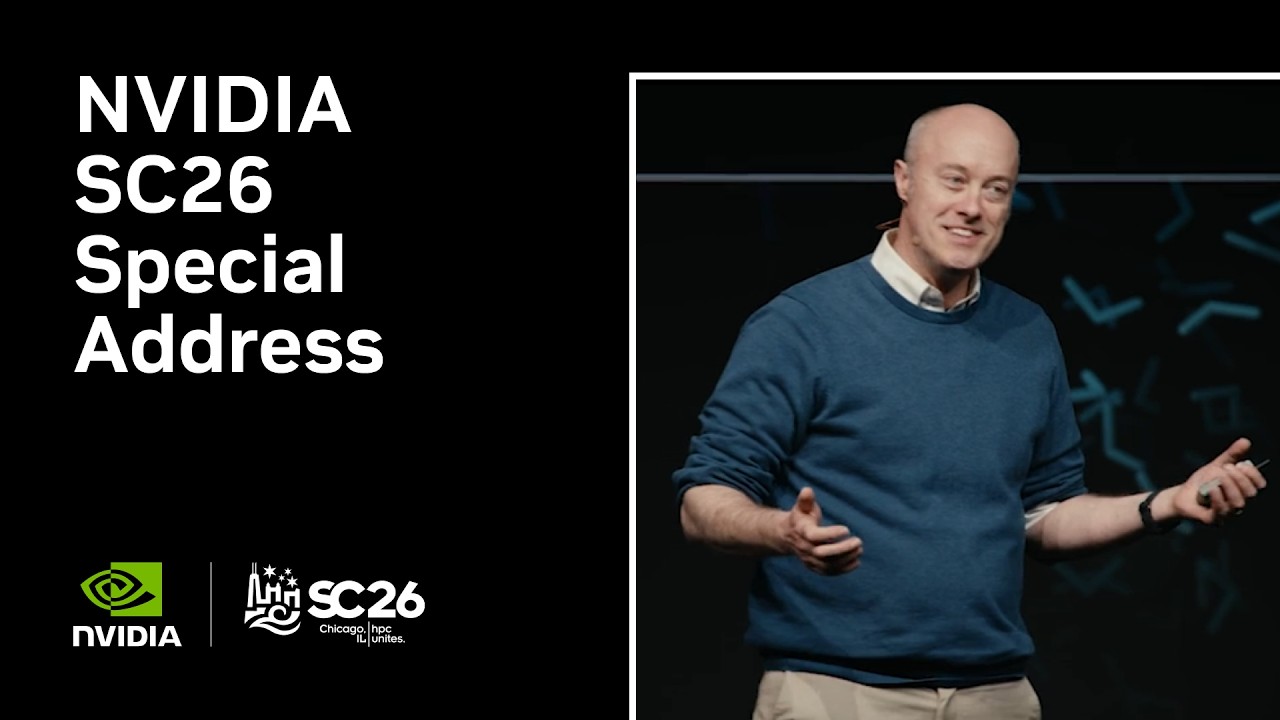
NVIDIA announced the DGX Spark during its SC26 Special Address as a Blackwell-powered computing device for local research. This hardware shift enables “agentic AI,” where researchers transition from viewing results to using AI agents to interact with instruments in real-time. HPC researchers should act on this new hardware and toolkit, while mobile gamers should skip it.
Who needs to act on this
Readers who should act on the DGX Spark and CUDA libraries
- HPC researchers should utilize the new HPC toolkit for DGX Spark to build and train science-specific LLM models and AI harnesses.
- Quantum computing scientists should implement magic state cultivation to reduce operation counts for logical calculations.
- Bio-medical researchers should deploy the cu_quant and Daiquiri libraries to automate high-throughput RNA reconstruction and microscopy.
- Radio astronomers should implement the KuPhoton library to achieve real-time correlation and visualization of astronomical data.
Readers who should skip the DGX Spark and CUDA libraries
- Mobile gamers should skip these HPC tools and look at NVIDIA GeForce gaming news for consumer hardware.
- General consumers looking for home PCs should skip these enterprise-grade research tools and look at NVIDIA consumer GPU guides.
What to do next about the DGX Spark and CUDA libraries
- Download the HPC toolkit for DGX Spark to build and train science-specific LLM models.
- Implement the KuPhoton library to achieve 3,700x data loading speeds in radio astronomy pipelines.
- Integrate magic state cultivation into quantum simulation workflows to reduce operations by 10x.
The Era of Agentic AI in Scientific Computing
NVIDIA’s move toward agentic AI—AI that can function as agents to interact with devices, instruments, and supercomputers—represents a fundamental shift in how research is conducted. Instead of humans manually interpreting large batches of data, agentic AI can navigate the data landscape to perform active problem-solving. This allows for a transition from passive simulation to active discovery where the agent becomes the primary interface for the research workflow.
What is Agentic AI?
Agentic AI is a category of artificial intelligence capable of acting as an independent agent to interact with other systems, instruments, or software to complete complex tasks. Unlike standard AI that only provides a prediction or a text response, agentic AI can navigate a toolset to perform actions, such as managing a scientific experiment or orchestrating a data pipeline.
DGX Spark: Bringing Blackwell to the Desktop
The DGX Spark serves as a small-form-factor, Mac Mini-sized version of a DGX, designed to be put on a desk and plugged into a wall. This device integrates Blackwell technology, allowing researchers to run high-performance computing (HPC) simulations locally. By moving these capabilities to the desktop, NVIDIA aims to democratize supercomputing for individual researchers and smaller labs.
The DGX Spark includes a dedicated HPC toolkit designed for building and training science-specific models. This toolkit provides the software stack necessary to create AI harnesses and train large language models (LLMs) for scientific discovery. The device supports multi-node scaling through NPI, allowing users to build a “mini supercomputer” that remains compatible with existing CUDA libraries.
Real-Time Discovery via New CUDA Libraries
NVIDIA announced a collection of new CUDA libraries that move scientific discovery from offline processing to real-time streaming. The core mechanism relies on moving data directly from instruments into GPU memory to eliminate the latency of manual data transfer. This enables researchers to see results as they happen, which is critical for tasks like fusion energy confinement or atomic microscopy.
The cu_quant library allows for the reconstruction of 1.2 billion RNA strands in approximately 2 seconds, a process that previously was a massive reconstruction hurdle for cancer research. For microscopy, the Daiquiri library enables the visualization of individual atoms by moving data off the instrument and into the GPU immediately. In the field of fusion, the KuPhoton library enables real-time plasma visualization, allowing researchers to monitor energy transfer as it occurs.
Key Scientific Applications of CUDA Libraries
- Spatial Biology: Reading 1.2 billion RNA strands in seconds for cancer research.
- Microscopy: Real-time atomic movement visualization using the Daiquiri library.
- Plasma Physics: Real-time visualization of fusion energy using the KuPhoton library.
- Astronomy: Real-time observation of black holes and galaxies via GPU-accelerated pipelines.
How the DGX Spark differs from the DGX Station
The DGX Spark and the DGX Station represent different approaches to NVIDIA’s HPC hardware, distinguished primarily by their form factor and intended deployment environment. While both utilize Blackwell technology, they serve different spatial requirements in a laboratory or office.
| Feature | DGX Spark | DGX Station |
|---|---|---|
| Form Factor | Small-form-factor (Mac Mini-sized) | Standard workstation form factor |
| Deployment | Desk-side / Local research | Workstation / Lab environment |
| Primary Goal | Democratized HPC for desktops | High-density research computing |
Accelerating Quantum Computing Simulations
NVIDIA’s advancements in quantum computing focus on reducing the number of physical cubits—the physical components of a quantum computer—required to perform a logical calculation. Because physical cubits are barely coherent, current research requires hundreds of physical cubits to perform just one logically relevant operation. By optimizing the algorithms to maintain coherence, researchers can move toward fault-tolerant quantum computing (FTQC).
The implementation of magic state cultivation provides a path to reducing the number of operations needed for a logical step by 10x. This technique is a critical component of fault-tolerant quantum computing, allowing for more stable and scalable quantum computation. By simulating these digital twins on GPUs, researchers can test error-correction algorithms before deploying them on physical hardware.
What is magic state cultivation?
Magic state cultivation is a quantum computing technique used to reduce the number of operations needed to perform a logical step. By optimizing how physical cubits are utilized, this method allows for more efficient error correction and increases the number of scientifically relevant logical cubits a system can support.
The new CUDA cube-based decoder further accelerates this field by reducing data processing time from 12 weeks down to 45 minutes on a GPU. This improvement allows researchers to test and iterate on quantum algorithms in minutes rather than months. The shift toward these high-efficiency algorithms is the primary way to reach the goal of 1,000 logical cubits.
Quantum Computing Performance Gains
- Previous processing time
- 12 weeks
- New processing time
- 45 minutes
- Operation reduction
- 10x (via magic state cultivation)
Visualizing the Cosmos with KuPhoton
The KuPhoton library addresses the problem of processing petabytes of radio astronomy data by bringing the scientific pipeline onto GPUs. This allows for the real-time correlation and visualization of data that was previously gathered over years and processed offline. KuPhoton enables scientists to see events like black hole formation as they unfold, rather than years after the fact.
KuPhoton accelerates data loading by up to 3,700x and correlation by up to 460x, scaling across multi-node systems. It enables data to be acquired at rates up to 345 GHz, which is essential for processing signals from the M87 galaxy. By overlapping loading with signal processing and reconstruction, it allows for the first time in human history to resolve light orbiting a black hole in real-time.
NVIDIA SC26 Special Address leaves these details unconfirmed
- NVIDIA has not confirmed the specific power requirements for the DGX Spark.
A Fusion Researcher’s Decision
Suppose Dr. Aris works at a fusion research facility and needs to visualize plasma behavior in real-time to maintain confinement. Currently, his team relies on offline processing, where they capture data and wait for days for it to be correlated and visualized. Aris decides to deploy the KuPhoton library onto a GPU-powered system to move the pipeline into real-time.
By using KuPhoton, Dr. Aris’s team can stream data directly from the reactor instrument, performing signal processing and reconstruction as it happens. They achieve real-time visualization, allowing them to make immediate adjustments to the reactor’s energy transfer. If Dr. Aris had not adopted the GPU-accelerated KuPhoton library, the team would have continued to wait for hours or days for data, making real-time confinement adjustments impossible.
While many researchers focus on the scale of the data, the true breakthrough in these tools is the reduction of complexity. Reducing 12 weeks of quantum processing to 45 minutes fundamentally changes the feasibility of the research itself. By removing the bottleneck of offline processing, NVIDIA’s Blackwell-powered hardware allows for a new era of real-time discovery.
Frequently Asked Questions
What is the DGX Spark and how does it work?
The DGX Spark is a small-form-factor, Mac Mini-sized computing device that uses Blackwell technology and a dedicated HPC toolkit. It allows researchers to build and run simulations, train LLM models, and create AI harnesses directly on a desktop.
How much did the new quantum decoder improve quantum data processing?
The new CUDA cube-based decoder reduces quantum data processing from 12 weeks down to approximately 45 minutes on a GPU. This allows for much faster iteration on error-correction algorithms.
What are the performance gains for the KuPhoton library?
The KuPhoton library accelerates data loading by up to 3,700x and correlation by up to 460x for radio astronomy applications. This allows for real-time processing of data from instruments like those used to observe the M87 galaxy.
To see a black hole using NVIDIA technology, researchers use the KuPhoton library to bring the scientific pipeline onto GPUs. This enables the real-time streaming and processing of radio signals from multiple observatories simultaneously.
Based on NVIDIA’s NVIDIA SC26 Special Address.
Related articles
- NVIDIA RTX Spark: 128GB Unified Memory for Local AI
- NVIDIA launches RTX Spark and DGX Station for local AI
- NVIDIA DGX Spark 64GB Launches for Local AI Development
ExtremeSpec is reader-supported: some links on this page are affiliate links, and as an Amazon Associate ExtremeSpec earns from qualifying purchases at no extra cost to you. Learn more.