AI Assisted Product Security at Intel: Scaling Hardware Security
ExtremeSpec is reader-supported: some links on this page are affiliate links, and as an Amazon Associate ExtremeSpec earns from qualifying purchases at no extra cost to you. Learn more.
Intel identifies over 10,000 security sightings using human-guided AI-driven analysis across hundreds of repositories to improve hardware security assurance. The core friction in this process is the waste of human expert time on false positives that must be filtered out before manual triage. Hardware security engineers should act on this.
Who should act on AI Assisted Product Security and who should skip it
Readers who should act on AI Assisted Product Security
- Hardware security engineers should adopt human-guided AI workflows to scale security reviews across vast product portfolios without being overwhelmed by noise.
- Firmware developers should integrate AI-assisted analysis into existing pull request workflows to identify secure coding issues earlier in the development lifecycle.
- Enterprise security architects should implement confidential computing and dynamic policy binding to safely deploy autonomous AI agents.
- Security researchers should study Intel’s use of deterministic checks to verify the reliability of AI-generated security findings.
Readers who should skip AI Assisted Product Security
- General consumers should skip this technical analysis and instead follow general device security best practices.
- Mobile software developers should skip this and focus on mobile-specific security documentation rather than silicon-level firmware.
What to do next about AI Assisted Product Security
- Perform deterministic checks against build evidence to rule out non-exploitable findings.
- Utilize static reachability and data flow analysis to filter candidate findings before human triage.
- Create static analysis rules for repeating AI-found patterns to ensure repeatable coverage.
Scaling Security Assurance through Human-Guided AI
Intel employs human-guided AI-driven analysis to examine hundreds of repositories, including critical security assets, platform firmware, driver, applications, services, libraries, frameworks, RTL, and silicon IP. This process surfaced over 10,000 sightings across the entire product portfolio. The goal of this scale is precision. The system is designed to provide engineers with evidence they can act on, minimizing the time experts spend on false positives. Human experts remain accountable for the final decision, bringing necessary product context to validate what the AI identifies.
What is a sighting?
A sighting is a candidate finding generated by an automated system that requires human review to determine if it is a true vulnerability, a weakness, or a false positive. Categorizing sightings allows security teams to filter out noise and prioritize the most dangerous flaws for immediate remediation.
What is RTL?
RTL, or Register-Transfer Level, is a way of describing digital circuits in hardware design. It represents the architecture of the data paths and registers within a chip. Security analysis at the RTL level allows engineers to find hardware bugs before the silicon is even manufactured.
The transition from manual security review to AI-assisted scaling requires significant infrastructure preparation. Engineers must define the specific permissions and boundaries for agents via policy definition. This ensures that as discovery scales, the human workload remains manageable and focused only on actionable issues.
Does the AI hallucinate results? Intel prevents this by requiring that every finding be backed by evidence from the actual software image. If the AI points to a document or a piece of code, experts verify that the AI quoted that source correctly before moving to the next step.
The Sighting Triage: Categorizing AI Findings
Anand Pashupathy, who leads product security at Intel, defines a “sighting” as a candidate finding that requires human training to determine its validity. The triage process sorts every sighting into one of three distinct categories. This distinction is vital for efficient engineering. If the distinction is ignored, engineers risk wasting weeks on non-exploitable code patterns.
The three categories for AI-driven vulnerability hunting are:
- True Positive: A vulnerability confirmed using the specific checks agreed for that review.
- Weakness: A real defect or risky condition that is not established as exploitable within the scope of the review.
- True False Positive: A finding where the evidence directly contradicts the vulnerability claim.
Intel uses deterministic analysis to verify AI findings against build evidence and product context
Intel utilizes deterministic analysis to verify the findings surfaced by AI. This involves testing candidate findings against build evidence and product context to assess exploitability. By using deterministic checks, the system can rule out unsupported claims before they ever reach a human expert’s desk. How can a human expert possibly validate thousands of results alone? They cannot, which is why this automated filtering is the core mechanism of the architecture.
What is Deterministic Analysis?
Deterministic analysis is a method of testing a finding against specific build evidence and product context to confirm it is exploitable. Unlike the probabilistic nature of AI, deterministic analysis provides a mathematical or logic-based certainty that a piece of code exists and can be reached.
The system also employs static reachability and data flow analysis to determine if a flagged pattern can actually be triggered by a user. If the evidence rules out the candidate, the finding is set aside. When the AI identifies a genuine, repeating pattern, it is converted into a static analysis rule. This allows for repeatable coverage of the codebase at a lower cost for each subsequent scan.
Intel maintains a predictable update cadence to pack more fixes into stable releases
Increased discovery does not automatically necessitate more frequent security updates. Intel maintains a predictable update cadence to help customers manage their own dependencies and workflows. Bringing fixes into a planned update cycle prevents customers from being “bamboozled” by an unpredictable flood of advisories. The goal is to pack more fixes into a stable, known release schedule rather than changing the frequency of the updates themselves.
The Intel platform update (IPU) process coordinates this delivery across the ecosystem. This allows participating partners to work together to validate and deploy mitigations. Predictability is the primary metric for customer success in hardware security.
Securing AI Agents with Confidential Computing
Trusting autonomous AI agents requires moving beyond simple identity checks to a system of multiple concurrent controls. An agent must be bound to a dynamic policy that defines its allowed actions in real-time. This is necessary because instructions hidden in a document could be interpreted as direct commands, leading to cascading unauthorized actions. Trust must be continuous; a check at startup is insufficient to authorize the entire duration of an agent’s session.
Intel utilizes confidential computing to protect data in use by keeping sensitive information in memory private from the host operating system and cloud operators. This also prevents tampering with the code and runtime within the protected environment. To ensure the integrity of the agent, Intel uses attestation to provide evidence that the specific approved code and model are running in the confidential VM.
To maintain privacy between sessions, a protected root key is used to keep the agent’s long-term memory private. The key is only recovered after the VM passes a new attestation and policy check. These mechanisms ensure that even if an agent is compromised, its reach is limited by hardware-enforced boundaries.
What Intel has not yet announced about the Q3 2026 security update
- Intel has not announced the specific date of the Q3 2026 security update.
- Intel has not provided the exact count of the “hundreds” of repositories scanned.
- The specific list of the 10,000+ sightings has not been publicly released.
The Impact of Deterministic Filtering on Hardware Engineering
Suppose Marcus, a hardware security engineer at a tier-1 OEM, is tasked with auditing a massive new SoC project. He is concerned that a standard automated scan will produce 10,000 results, most of which will be false positives, burying his team in useless work. Marcus chooses to implement a workflow based on Intel’s “sighting” model, where AI identifies patterns but is filtered by deterministic checks against build evidence and data flow analysis before reaching his team.
By using these filters, Marcus only receives a handful of True Positives and Weaknesses to triage, allowing his team to find and fix real vulnerabilities in weeks rather than months. However, if Marcus had skipped the deterministic check step, his team would have been forced to manually triage all 10,000 sightings, likely delaying the project’s security sign-off by months.
Frequently Asked Questions
How does Intel use AI to find hardware bugs faster?
Intel uses human-guided AI to scan hundreds of repositories for patterns, surfacing over 10,000 sightings. These findings are then filtered through deterministic checks and data flow analysis to ensure only true positives and weaknesses reach human engineers.
What is the difference between a sighting and a vulnerability?
A sighting is a candidate finding that needs to be trained by a human to determine its validity. A true positive is a vulnerability that has been confirmed using specific, agreed-upon checks to prove it is exploitable.
Will Intel release more frequent security updates because of AI?
Intel’s overall update cadence remains the same despite the increased discovery capabilities of AI. The goal is to maintain predictability for customers by bundling more confirmed fixes into the existing scheduled update windows.
How do I protect my data while an AI agent is processing it?
You should use confidential computing to create a protected environment that shields data in use. This ensures the agent can only access the data within a secure enclave that the host OS cannot see or tamper with.
By moving from probabilistic AI discovery to deterministic verification, Intel suggests a shift where the human’s role evolves from hunting for bugs to validating the rules that find them. This approach provides a path to scale security without overwhelming the human experts who must ultimately authorize the fixes.
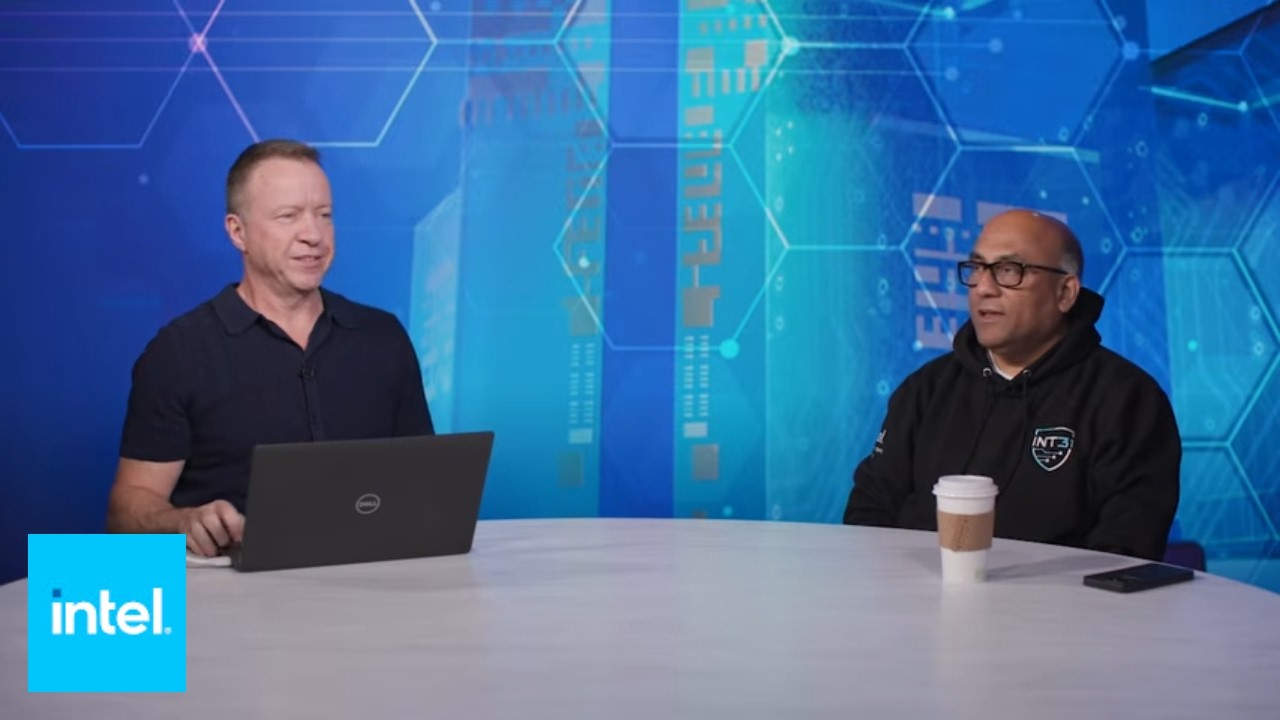
Details first shown in AI Assisted Product Security at Intel | Chips & Salsa | Intel by Intel.