AMD Ryzen™ AI Embedded X100 for Humanoid Robotics
The AMD Ryzen™ AI Embedded X100 allows developers to decouple motor control from cognitive architecture to enable fluid humanoid movement. While many focus on raw compute power, the architectural separation of these two systems is the primary bottleneck for creating natural-looking robots. The AMD Ryzen™ AI Embedded X100 suits robotics hardware engineers who need to solve motion jitter, while smart home hobbyists should look at consumer electronics.
Who should buy the AMD Ryzen™ AI Embedded X100 and who should skip it
Readers who should buy the AMD Ryzen™ AI Embedded X100
- Robotics hardware engineers should use the AMD Ryzen™ AI Embedded X100 to create independent computational paths for motion and cognition to reduce movement jitter.
- AI research developers should implement the morphology-based training methods described by Generative Bionics to create more human-like movement data.
- Robotics investors should prioritize platforms like the GENE robot that utilize open source digital twins to establish industry trust.
- Edge computing specialists should evaluate the X100 for its ability to provide a unified infrastructure from edge to cloud.
Readers who should skip the AMD Ryzen™ AI Embedded X100
- PC gamers should skip the X100 and look for standard AMD Ryzen gaming processors.
- Smart home hobbyists should skip this hardware and look at consumer-grade smart home devices.
What to do next about the AMD Ryzen™ AI Embedded X100
- Download the open source digital twin from the Generative Bionics repository to begin testing software before physical hardware arrives.
- Integrate the AMD Ryzen™ AI Embedded X100 into the motion control path to decouple it from cognitive tasks.
- Calibrate the multimodal skin sensors for proximity and touch to ensure the robot reacts to human presence.
The AMD Ryzen™ AI Embedded X100 as a Robotics Foundation
The AMD Ryzen™ AI Embedded X100 serves as the primary robot brain hardware for humanoids by providing a tailored compute infrastructure that spans edge computing, NPUs, GPUs, and CPUs. This unified architecture is essential because a single partner must customize the entire pipeline to be effective once the robot is deployed. By providing one single path for these diverse compute requirements, the X100 allows for a more cohesive integration of robot functions.
The X100 robot processor is designed to handle the high-intensity requirements of humanoid morphology. Because humanoid robots must mimic the physical form of human beings, they require specialized hardware to process complex sensor data in real time. The X100 provides this through a centralized compute architecture that balances different types of processing demands simultaneously.
What is morphology?
Morphology refers to the structural form and shape of a human being or robot. In robotics, matching a robot’s morphology to that of a human allows it to move in a way that is predictable and natural for people. This physical similarity is a prerequisite for creating robots that can safely inhabit human spaces.
Technical Specifications and Comparisons
| Component | AMD Ryzen™ AI Embedded X100 | NVIDIA Jetson | Intel OpenVINO |
|---|---|---|---|
| Primary Role | Humanoid Robotics / Edge-to-Cloud | Edge AI Processing | Inference Optimization |
| Architecture | Unified (CPU/GPU/NPU) | GPU-centric | Software Stack / Optimization |
| Key Feature | Decoupled Motion/Cognition | Low-power Edge Inference | Cross-platform Optimization |
The AMD Ryzen™ AI Embedded X100 must be evaluated against the NVIDIA Jetson, which provides a standard comparison for edge AI processing power. For software optimization, the X100 works alongside or competes with the Intel OpenVINO software stack for optimizing inference on edge hardware. Using the X100 allows for a more cohesive deployment of the robot’s intelligence.
Decoupling Motion Control and Cognitive Architecture
To understand how to make robots move naturally, engineers must move beyond simple processing and focus on the separation of motor control and cognitive architecture. Currently, many systems suffer from jitter because the robot’s ‘brain’ and its ‘muscles’ are competing for the same processing cycles. Why does a robot often appear jittery or ‘robotic’ when it’s performing a complex task? The X100 enables a solution by allowing the system to decompose these tasks into separate pathways. This means the robot can perform reflex-like motion tasks without waiting for the cognitive logic to complete its analysis.
Think of the X100’s architecture like a reflex arc in the human nervous system: the muscles react instantly to a stimulus, while the brain processes the context of the situation later. This separation ensures that the robot’s movement remains fluid regardless of how much cognitive processing is occurring. By acting as a robot motion control chip, the X100 prevents the ‘stop-and-think’ motion profile that characterizes lower-end systems. This architectural choice is what makes human-like fluid movement possible.
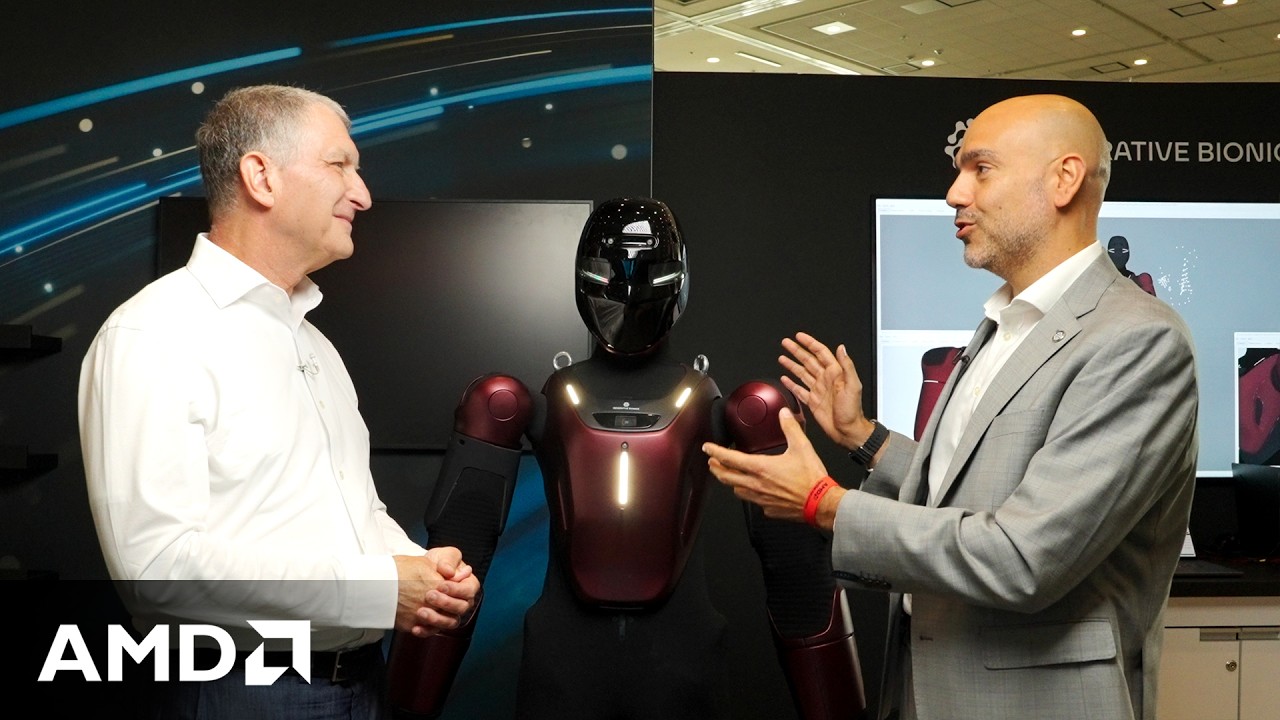
Generative Bionics uses multimodal skin to provide the GENE robot real-time sensing
Making robots safe around people requires more than just visual recognition; it requires the ability to sense physical proximity and touch. Generative Bionics uses multimodal skin, a sensor surface capable of perceiving both touch and proximity, to ensure the GENE robot reacts immediately when a human gets close. This technology provides the next generation of safety by allowing the robot to understand its physical boundaries in real time.
This safety level is achieved by feeding proximity and touch data into the X100’s centralized analysis tasks. By processing this data at the edge, the robot can trigger immediate defensive or corrective actions without relying on a cloud round-trip. This localized sensing is a critical component for any humanoid robot intended for public or domestic use.
The Role of Open Ecosystems and Digital Twins
The use of an open source digital twin is a fundamental requirement for establishing the trust necessary for the humanoid robotics industry to scale. A digital twin is a functional, data-driven replica of a specific hardware system that allows for real-time development and testing before physical hardware is even deployed. Generative Bionics provides an open source digital twin for the GENE platform, allowing developers to download the system and start working before the robot is delivered. This transparency allows users to see what is going on behind the scenes.
By opening the ecosystem, AMD and Generative Bionics allow third-party developers to build on a foundation of trust. Transparency in AI is vital because it is difficult to interpret the behavior of complex autonomous systems without access to the underlying logic. The availability of a digital twin means that developers can debug, train, and audit the robot’s behavior in a virtual environment. This removes the ‘black box’ risk that often prevents the adoption of humanoid robotics.
How to Train Robots Using Human Morphology
Generative Bionics achieved a turning point approximately two years and a half ago by learning how to digitalize human beings to extract large-scale training data. By extracting data from humans, they can train machine learning models that are specifically tuned to human morphology. This means the robot isn’t just learning to ‘move’; it is learning to move like a human. This data-driven approach allows for the deployment of models onto machines that share the same physical form as the human source. This is the key to achieving natural-looking movement.
This transition from general AI to morphological AI suggests that the future of robotics lies in mimicking the specific physical constraints of the human body. If a robot’s movement doesn’t account for human morphology, it will always feel unnatural to a human observer. By focusing on the physical form, researchers can create more effective and safer interactions between humans and machines.
The AMD Ryzen™ AI Embedded X100 decouples motion control from cognitive architecture
Suppose Elias is a hardware engineer at a robotics startup trying to build a humanoid that can walk while speaking. He notices that the robot’s legs jitter whenever the speech processing engine becomes active because both systems are competing for the same CPU cycles. To fix this, Elias must decide whether to buy more powerful processors or change his architecture. He chooses to implement the AMD Ryzen™ AI Embedded X100 to decouple the motion control from the cognitive architecture.
By using the X100, Elias creates two separate pathways: one for the high-frequency motor controls and one for the cognitive speech processing. The robot achieves fluid movement because the motion control is no longer waiting for the speech logic to finish. If Elias had used a standard processor without this separation, the robot would continue to stutter during complex tasks, making it appear less human and potentially less safe.
AMD Ryzen™ AI Embedded X100 leaves these details unconfirmed
- AMD has not announced the official release date for the AMD Ryzen™ AI Embedded X100.
Frequently Asked Questions
How does the AMD Ryzen™ AI Embedded X100 help in building humanoid robots?
The AMD Ryzen™ AI Embedded X100 enables the separation of motor control architecture from the cognitive architecture of the humanoid robot. This separation ensures that high-frequency motion tasks do not experience lag when the robot is performing complex cognitive reasoning.
What is the role of ‘multimodal skin’ in the GENE robot?
The multimodal skin allows the GENE robot to perceive both touch and proximity, which is necessary for the next generation of safety. It enables the robot to react immediately to a human’s presence or physical contact to ensure safe integration in human environments.
Is there a way to test the robot’s system before receiving the physical unit?
The platform provides an open source digital twin that can be downloaded from the Generative Bionics repository. This allows developers to start testing and training the robot’s systems before the physical hardware is delivered.
How do I train a robot to act like a human?
To train a robot to act like a human, developers can extract large-scale quantities of data from humans to train machine learning models. These models are then deployed onto machines that share a similar morphology to the human body.
Source: Generative Bionics CEO Daniele Pucci discusses humanoid robotics with AMD CTO Mark Papermaster (AMD).
Related articles
- Dell Distributed Private Cloud adds GPU-dense and rugged edge hardware
- Foundation Humanoid Robots: Engineering for Heavy Industrial Work
ExtremeSpec is reader-supported: some links on this page are affiliate links, and as an Amazon Associate ExtremeSpec earns from qualifying purchases at no extra cost to you. Learn more.