Can the RX 5700 XT Gaming X AI GPU train a small vision model?
ExtremeSpec is reader-supported: some links on this page are affiliate links, and as an Amazon Associate ExtremeSpec earns from qualifying purchases at no extra cost to you. Learn more.
You should verify your specific dataset size is under 5,000 samples before starting your first training run.
RX 5700 XT Gaming X 8GB VRAM limits large AI training tasks
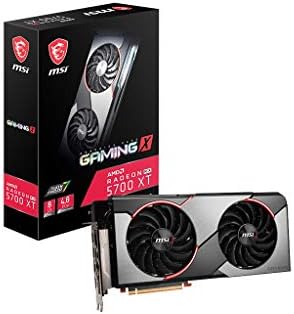
This graphics card—a component that handles the heavy math for visual recognition—uses 8GB of VRAM (video memory, which acts like a high-speed workspace for the GPU to hold active data) to store weights and gradients. Because training requires significant memory to avoid an out-of-memory (OOM) error, this 8GB capacity is a limiting factor for larger tasks. We selected this card for our comparison because it represents a common mid-range entry point for users looking to move beyond basic tasks into entry-level machine learning. For AI work, VRAM is the most critical bottleneck; having insufficient memory is like trying to bake a cake in a kitchen where the counter is too small to hold the ingredients.
For a summarized conclusion on this hardware, see our full RX 5700 XT Gaming X review.
What to Check Before Buying the RX 5700 XT Gaming X
Before purchasing this GPU for deep learning, verify these requirements for your specific workstation:
You can find a detailed breakdown regarding VRAM capacity for 13B models at 4-bit on our dedicated Q&A page.
- Confirm your power supply can handle the 225W power consumption of the card.
- Ensure your case has the physical clearance for the dual-fan design and the solid backplate.
- Verify your software environment supports ROCm, the open-source library used for training on this architecture.
- Check that your specific vision model requirements do not exceed the 8GB VRAM limit during the gradient calculation phase.
Comparing the RX 5700 XT Gaming X to Other Options
The RX 5700 XT Gaming X serves users who need a balance of cost and basic compute power for small-scale projects. If you need to train larger models or perform high-resolution image generation, you should look at cards with higher VRAM capacities. Buyers who require more than 8GB of memory for complex tensor operations (mathematical instructions that allow the GPU to process many data points at once) will find that this card’s memory limits will restrict their workflow. This model is suitable for learning the basics, but it lacks the headroom for professional-scale production.
For a balanced hardware choice, see our list of the best GPU for gaming and AI.
If you are training small-scale vision models on a budget, choose the RX 5700 XT Gaming X. For any project involving large language models or high-resolution image generation, look for a card with higher VRAM capacity.