
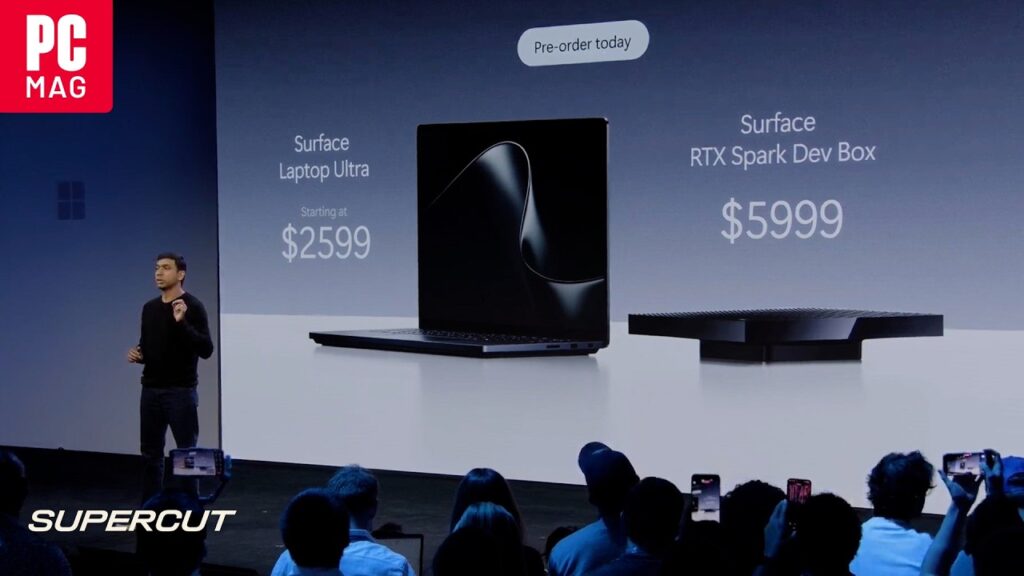
Microsoft CEO Satya Nadella introduced the Surface Laptop Ultra featuring up to 128GB of unified memory and 1 petaflop of AI compute. This move toward local “hybrid intelligence” allows users to run large models like the 130 billion parameter MAI Code 1.1 Flash directly on a laptop. The Surface Laptop Ultra suits high-end developers and creative professionals seeking local AI performance, while mobile-only users can skip this hardware.
Who should buy the Surface Laptop Ultra and who should skip it
Readers who should buy the Surface Laptop Ultra
- Software developers using GitHub Copilot should buy the Surface Laptop Ultra because it supports the MAI Code 1.1 Flash model with a 256k context window for local coding.
- Enterprise IT managers should buy the Surface Laptop Ultra because Microsoft Execution Containers (MXC) provide OS-enforced agent containment and attribution.
- Creative professionals (video editors) should buy the Surface Laptop Ultra because it offers more than 2.5x the thermal capacity of previous models for sustained loads.
- PC gamers should buy the Surface Laptop Ultra because it is confirmed to support the RTX Spark architecture for titles like Call of Duty in 2027.
Readers who should skip the Surface Laptop Ultra
- Mobile-only users should skip the Surface Laptop Ultra and look for information on mobile-specific AI features.
- Users seeking software-only AI tools should skip the Surface Laptop Ultra and check standard Copilot web app documentation.
What to do next about the Surface Laptop Ultra
- Pre-order the Surface Laptop Ultra today to secure production stock.
- Check the shipping schedule for RTX Spark laptops next Friday to coordinate hardware deployment.
- Configure the Surface RTX Spark DevBox with Project Zenith to establish a ready-to-code environment.
The move toward local “hybrid intelligence” in Windows
Microsoft is shifting toward a hybrid intelligence model where AI runs locally for immediate responsiveness and reaches the cloud only when necessary. This system uses intelligent routing to determine the best environment for a specific task, reducing both latency and cloud costs. While cloud-only AI providers may lose users to this local shift, enterprise IT departments gain the ability to manage AI agents as assets with policy enforcement. Local AI developers also gain access to 130 billion parameter models that were previously too large for portable hardware.
Security via Microsoft Execution Containers (MXC)
Microsoft Execution Containers (MXC) provide a runtime composable sandbox that isolates AI agents from the rest of the system. Windows enforces security policies on which files and networks an agent can access at runtime, ensuring that agent actions are restricted by policy. This architecture includes OS-level attribution, which treats an agent as a separate identity from the human user. By separating these identities, the system can block a risky agent without locking the user out of their own machine.
What is Microsoft Execution Containers (MXC)?
Microsoft Execution Containers (MXC) is a runtime composable sandbox that contains AI agents and enforces policies on files and networks. It ensures that local AI agents are secure and contained by providing a cross-platform library that is deeply integrated into the Windows OS.
Microsoft optimized the 130 billion parameter MAI Code 1.1 Flash for local execution
The MAI Code 1.1 Flash is a 130 billion parameter coding model that Microsoft has optimized for local execution on consumer hardware. By using 3-bit precision, Microsoft reduced the model’s size by nearly 80% while preserving coding quality. This engineering feat allows the model to work at an impressive 256k context window right on the device, enabling developers to process large amounts of code without cloud dependencies.
What is MAI Code 1.1 Flash?
MAI Code 1.1 Flash is a 130 billion parameter coding model designed for real-world developer workloads. It uses 3-bit precision to reduce its size by nearly 80% while supporting a 256k context window on local hardware.
Surface Laptop Ultra uses Nvidia RTX Spark architecture for 1 petaflop of AI compute
The Surface Laptop Ultra is built around the Nvidia RTX Spark architecture to support models that do not fit on traditional machines. It features up to 128GB of unified memory and a 1 petaflop of AI compute, while remaining under 18 mm thin and weighing less than 4.12 lbs. The device maintains over 99% of its power while on battery and offers 2.5x the thermal capacity of existing Surface Laptops. A new “Magnetic Connect” feature provides the world’s first built-in magnetic USB-C charging for convenience.
What is Unified Memory?
Unified memory is a memory architecture where the CPU and GPU share the same pool of memory. This allows large AI models to access more memory than would be available on a traditional discrete GPU, enabling the execution of models that “simply don’t fit” on standard machines.
Surface Laptop Ultra Key Specifications
- Memory
- Up to 128 GB Unified
- AI Compute
- Up to 1 Petaflop
- Thickness
- Under 18 mm
- Weight
- Less than 4.12 lbs
- Battery Power
- Over 99% on battery
- Thermal Capacity
- More than 2.5x existing models
The Surface Laptop Ultra delivers faster time to first token for language models and shorter image generation time than M5 Pro powered laptops. This performance is sustained by the increased thermal headroom, which prevents the throttling typical of thinner laptops under heavy AI loads. If the hardware did not support 128GB of unified memory, the 130 billion parameter model would not fit on the device.
The RTX Spark ecosystem and workstation capabilities
The Nvidia RTX Spark architecture is supported by a broad ecosystem of partners including Lenovo, Asus, Dell, MSI, and HP. These laptops are available for pre-order today and will begin shipping next Friday. For users requiring even greater power, the DGX Station for Windows provides data center class performance for local AI development. The HP ZGX Fury AI station further expands this by allowing work to scale simultaneously across 32 agents for development teams.
What Microsoft has not yet confirmed about the Surface Laptop Ultra and RTX Spark
- Microsoft has not announced the official retail price for the Surface Laptop Ultra.
- Microsoft has not announced the specific warranty terms for the RTX Spark components.
- Microsoft has not announced the specific regional availability dates for the Surface Laptop Ultra.
A compliance officer uses the Surface Laptop Ultra for AI deployment
Sarah, a compliance officer at a medical tech startup, needs to deploy AI agents to handle patient scheduling but fears that an agent might access restricted files. She chooses the Surface Laptop Ultra because it uses Microsoft Execution Containers (MXC) to provide OS-enforced agent level attribution. Because the OS treats the agent as a separate identity, she can authorize the agent to perform specific tasks without giving it “god-mode” access to her account. If the attribution was software-only rather than OS-enforced, Sarah would reject the system because a compromised agent could still masquerade as her user identity.
Frequently Asked Questions
How does Microsoft secure AI agents on Windows?
Microsoft secures AI agents through Microsoft Execution Containers (MXC), which provide a runtime composable sandbox. Organizations can set policies for file and network access that the Windows OS enforces at runtime.
What is the context window for the MAI Code 1.1 Flash model?
The MAI Code 1.1 Flash model supports an impressive 256k context window right on the device. This allows it to handle large coding projects locally with low latency.
Does the Surface Laptop Ultra perform well on battery?
The Surface Laptop Ultra maintains over 99% of its power while on battery power. This allows it to maintain sustained performance for AI tasks without being tethered to a wall outlet.
Can I run large coding models locally on a laptop?
You can run large models like the 130 billion parameter MAI Code 1.1 Flash locally on a laptop with 128GB of unified memory. The 3-bit precision reduction allows these models to fit into the laptop’s memory while preserving coding quality.
Details first shown in Watch the Surface Laptop Ultra Unveiled at Windows Event by PCMag.