
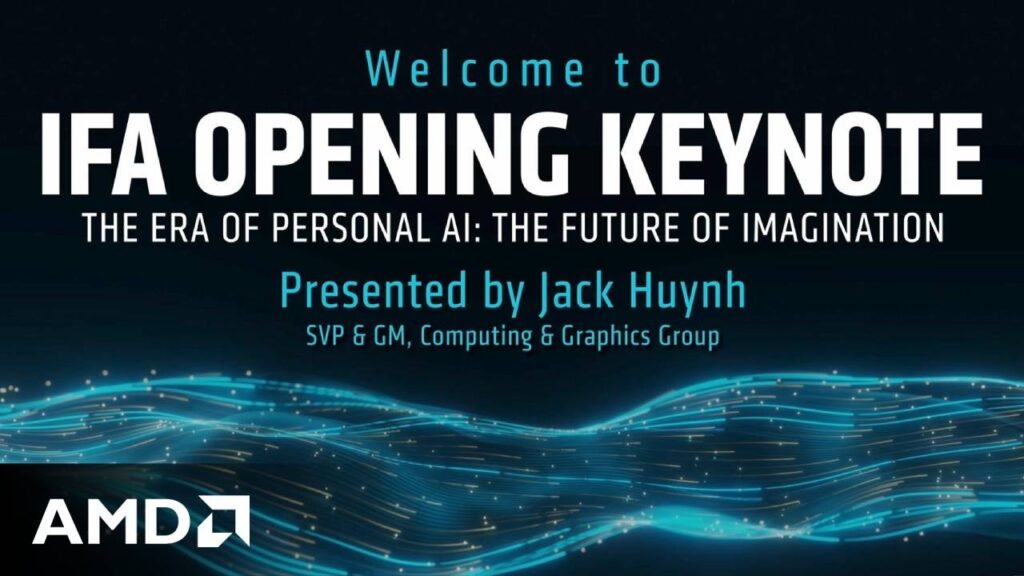
AMD’s Gorgon Halo platform provides 192GB of unified memory to support 300 billion parameter models locally on personal hardware. This hardware shift marks the beginning of the “Era of Personal AI,” where local execution replaces cloud reliance for complex, autonomous tasks.
Key takeaways from the AMD IFA 2026 keynote
- Agentic AI shifts the paradigm from simple chat to systems that can plan, use tools, and work in parallel.
- Monthly AI token processing is projected to reach 120 quadrillion by 2030 due to agentic workflows.
- Strix Halo provides 120GB of unified memory for 200B parameter models.
- Gorgon Halo provides 192GB of unified memory for 300B parameter models.
- Local inference removes the per-token costs that currently cause 93% of companies to exceed their AI budgets.
Agentic AI shifts the focus to multi-step reasoning
Agentic AI—AI systems that can plan, use tools, check their own work, and act autonomously rather than just answering prompts—requires a significantly different compute profile than standard chatbots. A standard chat might use a few thousand tokens, but a complex agentic task, like planning a multi-city vacation, can consume millions of tokens in a single session. This shift moves AI from a tool that retrieves information to a partner that can execute workflows.
Projected token demand illustrates the scale of this transition. Monthly AI token processing jumped from 0.7 quadrillion to 1.7 quadrillion in just one year, but the jump to 120 quadrillion by 2030 assumes the adoption of continuous agentic workflows. This scale of consumption creates a “compute multiplier” where every increase in agent capability requires a corresponding increase in background processing.
Unified memory solves the hardware memory wall
Unified memory—a memory architecture where the CPU and GPU share the same pool of memory—is the primary requirement for running frontier-class models on a local PC. AMD’s Strix Halo provides 120GB of unified memory to run models as large as 200 billion parameters. Gorgon Halo expands this capacity to 192GB of unified memory to support 300 billion parameter models.
The Gorgon Halo platform provides 192GB of unified memory for 300B parameter models, which is an 80GB increase over the 120GB of Strix Halo used for 200B parameter models. This expansion allows users to run models that were previously restricted to data centers or high-end cloud instances. Why does local execution matter for privacy? Personal AI requires that sensitive data like conversations and files stay on the device rather than moving to the cloud.
Local inference changes the economics of frontier AI
Local inference eliminates the per-token costs that make high-volume cloud usage prohibitively expensive. Cloud costs for 10 million output tokens can range from 90 euros on Sana 5 to 500 euros on Fable 5. On local hardware like Gorgon Halo, the cost is a one-time hardware investment rather than a recurring per-token fee. This shift is critical because 93% of companies are currently exceeding their AI budgets due to the scaling costs of cloud-based models.
Local performance is now rivaling cloud capabilities. Laguna S2.1, an open-source model running entirely on Strix Halo, actually scores higher than the cloud-based Sana 5 on a software engineering benchmark. Similarly, GLM 5.3 Flash running locally on Gorgon Halo delivers better performance than the leading cloud model Fable 5. This proves that the move to local compute does not require a compromise in intelligence.
New hardware launches for the era of personal AI
HP and Lenovo have already begun deploying this hardware in flagship products. The HP ZBook “Sunday” is a next-generation laptop featuring 190GB of unified memory powered by Gorgon Halo. Lenovo’s ThinkCentre X also utilizes the Gorgon Halo platform to provide enough memory for 300 billion parameter models in a desktop form factor.
Gorgon Halo hardware is designed to provide the specific memory headroom needed for the next generation of local agents. This allows developers to build applications that do not rely on external APIs, ensuring that data remains on the local machine. This transition moves the frontier of AI from a distant cloud server to the device in front of the user.
Who should act on this and who can skip it
- Software developers building autonomous agents should prioritize Gorgon Halo systems to run 300B parameter models locally without cloud budget constraints.
- Enterprise IT procurement officers should evaluate local inference hardware to mitigate the 93% of companies currently exceeding their AI budgets.
- High-end mobile workstation users should consider the HP ZBook “Sunday” to gain 190GB of unified memory for local privacy.
- Hardware research analysts should monitor the expansion of unified memory to 192GB as a benchmark for next-gen AI PCs.
- Smartphone users looking for mobile app tips should skip this and look at mobile-specific hardware reviews.
- Software-only AI enthusiasts should skip this and look at model-specific software documentation and tutorials.
AMD, HP, and Lenovo have not confirmed Gorgon Halo pricing, dates, or 192GB benchmarks
- AMD has not announced the retail price for the Gorgon Halo developer box.
- HP and Lenovo have not confirmed the specific release dates for the “Sunday” laptop or the ThinkCentre X.
- Independent benchmarks comparing the 192GB unified memory performance against NVIDIA’s cloud instances are not yet available.
A software engineer’s transition to local AI
Sarah is a software engineer who needs to run an agent to write, test, and debug a complex application. She currently uses a cloud API but is hitting a budget ceiling due to high token consumption for her large codebase. Sarah identifies that her agentic workflow requires high reasoning, making it a candidate for a large model, and she evaluates the Gorgon Halo platform which offers 192GB of unified memory.
Sarah switches to a workstation powered by Gorgon Halo, which allows her to run a 300 billion parameter model locally. She eliminates the 500 euro per 10 million tokens cloud cost and keeps her company’s proprietary code on her local machine. If Sarah only needed to run a small 9 billion parameter model, she would have instead used the Strix Halo platform with 120GB of unified memory.
Decision criteria and requirements
Current AI workflows typically rely on cloud-based models that charge per token, but the Gorgon Halo platform replaces this with a one-time hardware cost. If you already use small 9B parameter models like Qwen 3.5 on standard hardware, the jump to Gorgon Halo does not change your current workflow. The recommendation for local hardware holds as long as the one-time hardware cost remains lower than a 3-year cloud subscription for high-volume users; if the hardware price exceeds that cost, cloud remains the cheaper option.
Guessing wrong on memory requirements results in a system that cannot load the model, while overspending on cloud costs risks the budget overruns currently affecting 93% of companies. To verify these claims, users should compare the 192GB unified memory specification against the requirements for 300 billion parameter local inference.
- Agentic AI
- AI systems that can plan, use tools, check their own work, and act autonomously rather than just answering prompts.
- Unified Memory
- A memory architecture where the CPU and GPU share the same pool of memory, critical for running large models locally.
- Token Consumption
- The units of text or data processed by an AI model; agentic AI increases this due to continuous reasoning.
- GPQA
- A demanding graduate-level reasoning benchmark used to evaluate model intelligence.
Reported from IFA Opening Keynote replay, presented by Jack Huynh, published by AMD.