
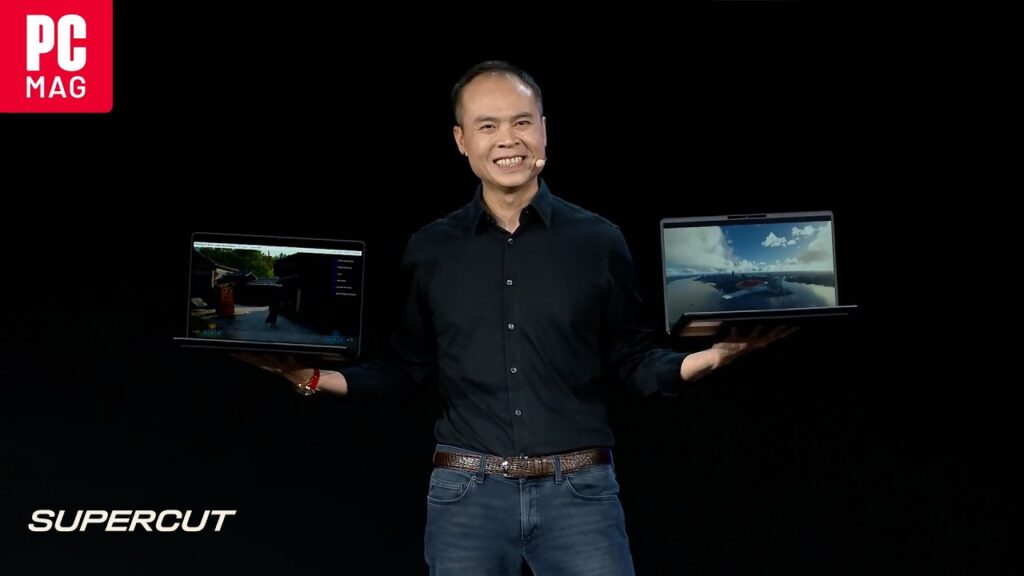
AMD’s IFA 2026 keynote introduced a new hardware trajectory where personal devices execute Agentic AI—AI that understands goals and works continuously—locally. The hardware reveals a shift toward high-capacity unified memory to eliminate the data bottlenecks currently hindering local large language model (LLM) performance.
AMD Unveils Halo Architecture for Local AI
AMD announced the Strix Halo and Gorgon Halo processors to facilitate the transition from cloud-dependent chatbots to local, context-aware agents. These chips allow users to run large models directly on their hardware, keeping personal data local and private. The hardware move addresses the massive growth in AI token processing, which jumped from 0.7 quadrillion to 1.7 quadrillion tokens in just one year.
The hardware targets a future where monthly AI token processing reaches 120 quadrillion by 2030. Local execution removes the economic burden of cloud computing, which can cost roughly $300 a day for high-volume users. The hardware makes it possible to run models that previously required data center infrastructure on a desktop or laptop.
Unified Memory Architecture as the Performance Mechanism
Unified Memory Architecture (UMA)—a system where the CPU and GPU share a single memory pool—serves as the primary mechanism for this leap. Standard memory configurations often create a bottleneck when trying to load large models into the GPU. UMA solves this by allowing the processor and graphics unit to access the same memory pool simultaneously.
Think of unified memory as one shared desk rather than two separate workspaces. This architecture allows the system to allocate more memory to the AI model, enabling the execution of much larger parameter counts. This mechanism ensures that the hardware is no longer restricted by the split between system RAM and video memory.
Strix Halo and Gorgon Halo Specifications
Strix Halo features 120 GB of unified memory, which AMD says supports models as large as 200 billion parameters. The Gorgon Halo pushes these limits further with 192 GB of unified memory to support models up to 300 billion parameters. Lenovo has already debuted the ThinkCenter X, a desktop powered by the Gorgon Halo chip.
The Strix Halo demonstrates that local performance can rival cloud-based options. In software engineering benchmarks, a model running on Strix Halo outperformed some cloud-based equivalents. This hardware allows users to carry the power of a cloud subscription in their backpacks.
AMD AI Hardware Specifications
- Strix Halo
- 120 GB Unified Memory | 200 Billion Parameter Support
- Gorgon Halo
- 192 GB Unified Memory | 300 Billion Parameter Support
- Threadripper Halo Station
- 96 Cores | 2 TB System Memory | 576 GB HBM3e
- Project Zenith Requirement
- 64 GB Minimum UMA
The Threadripper Halo Station Supercomputer
The Threadripper Halo Station serves as a 96-core “personal supercomputer” for extreme AI workloads. This workstation includes two MI 350P Instincts with a potential path to four total GPUs. The system utilizes a liquid-cooled design to maintain silent operation while delivering high-performance compute.
The station provides up to 2 terabytes of system memory and 576 GB of HBM3e. This hardware is specifically engineered to run AI models with more than a trillion parameters. It represents the highest end of the local compute spectrum for data scientists and research labs.
Project Zenith and Microsoft Partnership
Project Zenith offers a ready-to-code Windows experience on developer-class hardware through a partnership with Microsoft. The experience includes pre-installed tools like VS Code, WSL, GitHub Copilot CLI, and PowerShell. This setup ensures that developers have a curated environment optimized for high-end devices.
The software environment requires a minimum of 64 GB of UMA to ensure performance for large local models. AMD states that Project Zenith will be available out of the box on Ryzen AI Halo hardware. This collaboration aims to make AI development more accessible by removing the need for complex local environment setup.
Who this affects — and who can ignore it
AI developers building on Windows benefit from Project Zenith, which provides a pre-configured environment to start coding immediately without cloud overhead. Workstation buyers and data scientists gain the ability to run massive models with more than a trillion parameters using the Threadripper Halo Station. Professional creators, such as 3D artists, can use the HP ZBook “Sunday” to generate entire 3D worlds from a single prompt locally.
Privacy-conscious enterprise users gain the ability to keep sensitive data on-site while still utilizing advanced AI. Cloud AI providers may see a reduction in demand for high-volume, high-cost token processing as users shift to local hardware. Mobile and tablet users can ignore these specific updates, as the news focuses on high-end PC and workstation hardware; these users should instead look for news regarding mobile-specific NPU integrations.
Software-only developers should ignore this hardware-centric announcement. The focus is on memory bottlenecks and physical hardware specifications rather than coding languages or cloud APIs. These users should look for general software development blogs or cloud API documentation instead.
A Worked Example for Local AI
Sarah is a software engineer who currently pays for a cloud subscription to run large language models, which costs her roughly $300 a day for her heavy workload. She sees that Gorgon Halo can support 300 billion parameters and decides to switch to local compute to save on her $100,000 annual cloud cost. She purchases a Lenovo ThinkCenter X to run her models locally.
The decision flips if Sarah’s specific model was smaller than 200 billion parameters. In that case, she could have opted for the more portable Strix Halo hardware instead of the desktop station. The choice to move to local compute remains viable as long as the target model is under 300 billion parameters; if the requirement exceeds this, the Threadripper Halo Station is required.
Unconfirmed Specifications and Availability
The source does not price the top configuration of the Threadripper Halo Station. The source does not provide specific shipping dates for the Strix Halo or Gorgon Halo chips. The source does not specify warranty terms for the new workstation hardware.
Independent benchmarks for the 300-billion-parameter model are not yet established by third parties. Performance under sustained load for the Threadripper Halo Station is not confirmed by the manufacturer. Availability of the HP ZBook “Sunday” in specific regions remains unconfirmed.
Key terms
- Agentic AI
- AI that understands goals and works continuously rather than just executing single commands.
- Unified Memory Architecture (UMA)
- A memory architecture where the CPU and GPU share the same memory pool.
- Project Zenith
- A ready-to-code Windows experience on developer-class hardware with pre-installed tools.
Details first shown in AMD IFA 2026 Keynote: The Era of Personal and Agentic AI | Supercut by PCMag.